HAMMABORG: Historical Swordsmanship
  Deutsche Version
Equipment

We use a good number of weapon simulators in combination with historical and modern pieces of armour to train various aspects of combat. We employ padded weapons, wooden wasters, shinais and blunt replicas of historical originals. Besides, we use sharp weapons for test-cutting. If you wish to acquire arms, armour, or other equipment, we'd be glad to help. 

Our main focus is on fighting with two-handed longsword and one-handed sword, the latter often in combination with shield or buckler. But there are also axes, daggers and sabres to be found in our arsenal. Since summer 2005 we also teach spear-fighting. 

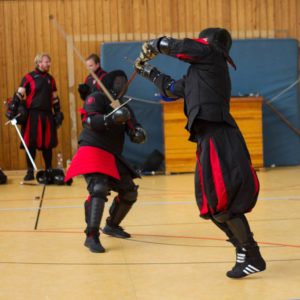
Since sparring has always been an important part in our endeavour, and since a lot of techniques require full-speed fighting with steel weapons, adequate protective gear is absolutely essential. Gloves or gauntlets, helmets or fencing masks, and a vast array of all kinds of body protection are being utilized. Still, time and again, we do spar with only little, or no protective gear at all, in order to train our feeling for danger and precision.

Video: Sparring Equipment (in English)


Longswords (steel)

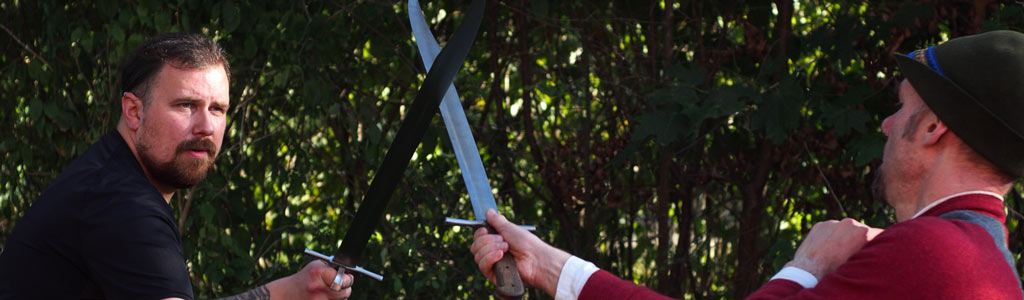
In order to reconstruct historical fencing techniques ass authetically as possible, we use steelswords that should resemble the historical originals very closely. Unfortunately, a large number of replica swords are far too heavy since they have a blunt edge of 2 or 3 mm for safety reasons. In contrast to a sharp weapon this surplus material results in a higher weight.

For this reason our steelswords are a compromise: In order to achieve a more historical weight (about 1500 to 1900 g) the blade has to be either narrower, or, maintaing an original breadth, show a deeper and/or longer fuller.

Longswords (aluminium)

Of course, only a sword made of steel can feel like a historical original. For that reasson any sword-simulator from a different material can be nothing more than a compromise. If you want to wield a steelsword you have to know how the weapon behaves, and you have to be able to control it properly because the energy that can be generated with ablow can easily cause severe injuries.

Occasionally we use aluminium swords. These weigh about 1,4 kg and are only slightly lighter than our steelswords. The blunt edges are much thicker (6mm) and also the point is considerably broader.

Longswords (wooden wasters)

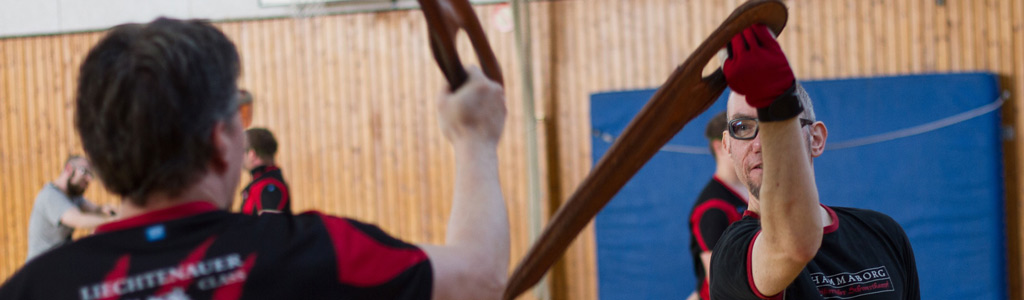
Wooden swords were in fact used in the past as training weapons but since they behave in a rather clumsy and not very dynamic way, we only use them for training correct hitting techniques, and for some aspects of winding/Winden when the swords have bound together.

However, they are entirely useless for freeplay and sparring. Wasters may diminish the risk of injuries because of their lesser weight but thrusts create a far greater danger since a wooden sword doesn't bend at all - but a steelsword does. This thrusting energy can't be deflected at all.

Splinters are another danger, so it is advisable to wrap the blade and the crossguard with sturdy duct tape.

Swords (steel)

What was said about our steel longswords is relevant for our one-handed swords too. Nevertheless we do use them - and preferably so - in freeplay.

Since they are wielded in only one hand and since their weight is just something about 1100 g, they are not as devastating as longswords can be. So they are an excellent choice for fighting with and are superior to any other simulator made from a different material.

"Langes Messer" (steel)

Also with the "langes messer" we endeavour to study the techniques with training weapons as authentic as possible. Our steel ones weigh about 900 to 1000 g and are superbly suitable for drills and freeplay.

The pair shown here was hand forged based on our very own drawings and calculations as a commisioned work. Inspiring examples were found in the most extensive source about the "langes messer", Johannes Lecküchner's fechtbuch Cgm 582. Like many originals, the protruding "wehrnagel" on the right side goes entirely through blade and crossguard and is riveted on the opposite side.

"Langes Messer" (aluminium)

Aluminium messers have a considerably thicker blade in comparison to steel ones. They weigh something between 700 and 1100 g, but although the weight is approximately the same as with the steel mesers and even the point of gravity is quite similar, they differ noticeably in their handling.

The aluminium messers too have a typical hilt with two lateral wooden plates. Gripping them with the lacrosse gloves we prefer is unfortunately distinctly more slippery than a leather covered hilt.

Wooden sticks

We employ a vast number of wooden sticks (preferably ash) in all conceivable sizes in order to simulate daggers or swords when it comes to the basics, like training the correct hitting technique for instance. We advise to round both ends with a file and to strengthen the stability of the sticks with a sturdy tape in order to prevent them from splintering. We use longer sticks as targets for hitting drills.

Bucklers

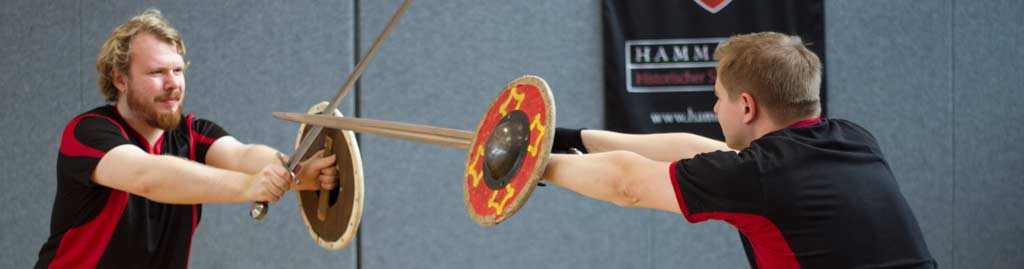
Bucklers have a diameter of about 30 cm and are either made entirely of steel or of wood with a central steel boss.

We use bucklers for both defense and offense, so it should be quite sturdy. Steel bucklers thinner than 2 mm have proven to be insufficient.

Fencing masks

Our favourite head protection is a fencing master mask as it is used in sports fencing. Its wire mesh is particularly robust. Since it leaves the back of the head completely unprotected it is essential to create a proper pretection for oneself.

Throat protection

The fencing mask does have a moderate throat protection but in a fight the tip of a sword might easily pass underneath and endanger the larynx. In order to prevent this, a throat protection (like it is used in hockey) is elementary.

Gloves

Since the hands are the target closest to the opponent they are particularly in danger of getting hit. So one should take good care in protecting them. Lacrosse gloves offer a very sturdy yet flexible solution.

Of course, one might consider alternatives such as padded gauntlets made of steel or leather.

Body protection

As protective gear for the torso we preferably use long-sleeved leather fencing masters' vests which come with an internal extra padding. Underneath a special plastiv breast protection may be worn, that is also common in sports fencing. Additionally we recommend light lower arm protectors from Escrima.

In order to protect the thighs and the hips, we rely on padded shorts, so-called girdles, from different hockey varieties. Often the junior size is sufficient and can be worn underneath regular sports wear.

Joints, arms and other exposed parts of the body are covered by other modern protectors from a variety of sports, e.g. lacrosse, inline-skating, hockey, etc. Gentlemen should advisably wear a cup.